The first week of March 2026 has marked a structural shift in the battery lifecycle. The industry is transitioning from a “collect and store” mentality to a sophisticated “urban mining” model. Driven by proprietary hydrometallurgical breakthroughs and a hardening of regional trade policies, battery recycling is now a core pillar of industrial energy security.
For C-suite executives, this week’s developments confirm that the circular economy is no longer a sustainability elective. It is a mandatory strategy for securing domestic mineral supplies.
1. The 99% Recovery Benchmark: India’s Technical Leap
On March 6, 2026, India’s Technology Development Board (TDB-DST) announced significant financial backing for MiniMines Cleantech Solutions. The project focuses on the commercialization of an indigenous, zero-discharge recycling process.
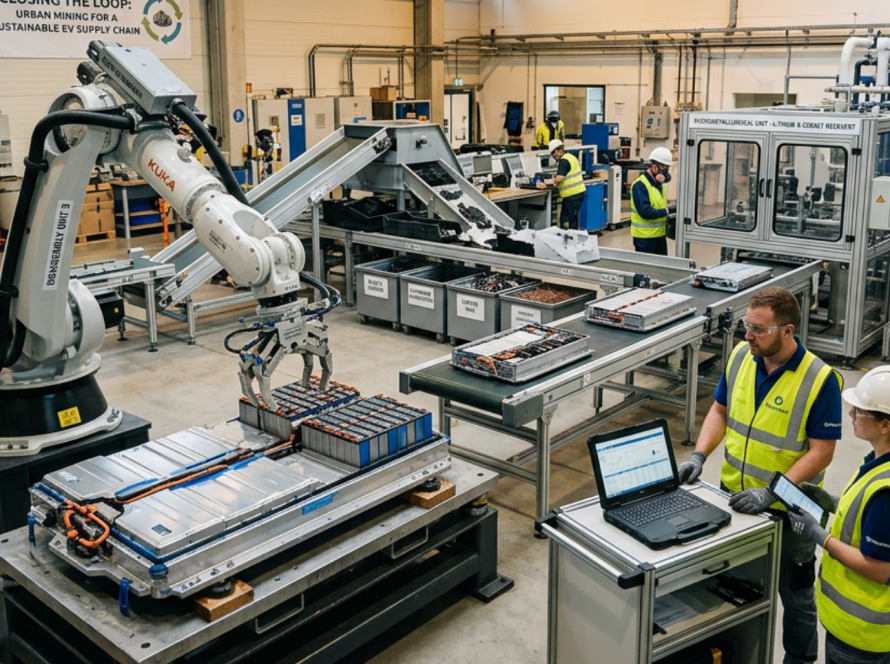
- Technical Milestone: The proprietary Hybrid Hydrometallurgy™ process has achieved recovery rates of up to 99% for lithium, cobalt, nickel, and manganese.
- Strategic Impact: By converting end-of-life batteries into high-purity battery-grade salts, this initiative reduces import dependence and provides a localized feedstock for India’s burgeoning giga-factory ecosystem.
2. Europe’s “Made in EU” Regulatory Shift
On March 4, 2026, the European Commission proposed the Industrial Accelerator Act (IAA). This legislation adds a new layer of complexity to the existing EU Battery Regulation.
- The Mandate: The Act introduces “Made in EU” stipulations for electric vehicles, favoring manufacturers that can prove high levels of regional value add.
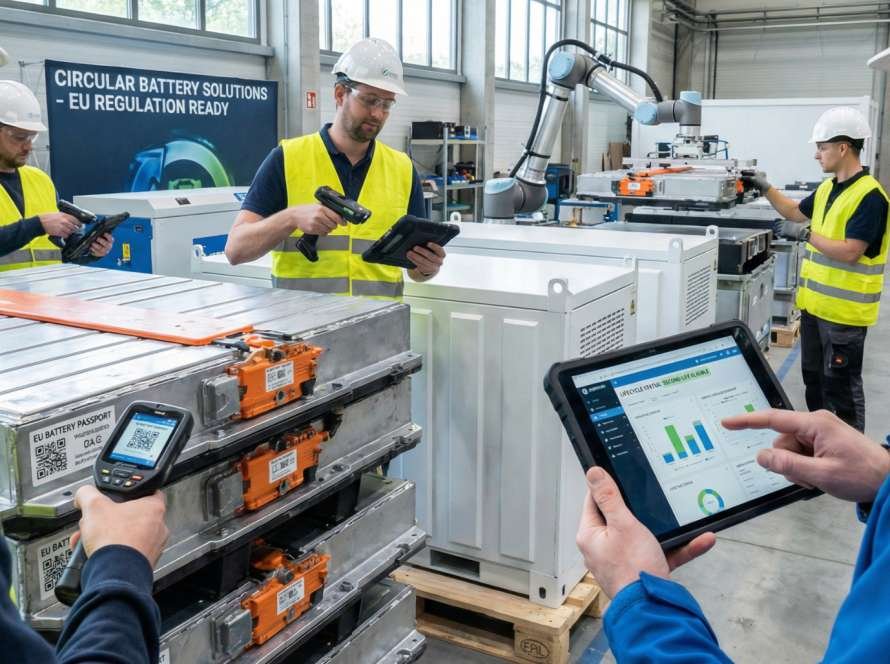
- Recycling Link: This policy reinforces the need for the EU Battery Passport, which becomes mandatory in 2027. Recyclers are now under pressure to provide 100% digital traceability for all recovered minerals, effectively turning recycled content into a “regulatory currency” for automakers operating in the bloc.
3. North American Scaling and Capital Influx
While policy drives the East and West, North America is focusing on massive infrastructure deployment.
- Canada’s Windsor Milestone: On March 5, 2026, NextStar Energy (a joint venture between LG Energy Solution and Stellantis) held the grand opening of its $5B CAD facility in Windsor. While primarily a manufacturing hub, it serves as the anchor for a closed-loop ecosystem where manufacturing scrap is immediately fed back into regional recycling streams.
- Redwood’s Expansion: In the U.S., Redwood Materials confirmed a fresh financing boost from investment arms associated with Google and Nvidia. The capital is specifically earmarked to expand its energy storage division, utilizing 100% domestic and recycled battery materials to power the AI data center surge.
4. UK’s Profitable Growth Model
Further proof of the sector’s maturity came from the UK, where Recyclus launched a new crowdfunding drive on March 5 following a year of 179% revenue growth. The company reported its first profitable months in late 2025, signaling that the unit economics of lithium-ion recycling have finally stabilized despite the volatility of virgin metal prices.
The Bottom Line
The landscape of EV battery recycling in 2026 is defined by chemical precision and policy protectionism. With recovery rates hitting the 99% threshold and major capital backing from the tech sector, recycled minerals are no longer just “green alternatives.” They are the most secure assets on the balance sheet. For the C-suite, the 2026 mandate is to ensure that your recycling partnerships are as robust and technically advanced as your primary supply contracts.