A New Phase for Circular Energy and Resource Security
The electric vehicle industry is entering a pivotal stage. As production and adoption accelerate worldwide, the focus is shifting toward how to manage end-of-life batteries responsibly and profitably. A new report from Vantage Market Research projects that the global EV battery recycling market will grow from USD 0.57 billion in 2024 to USD 24.5 billion by 2035, representing a compound annual growth rate of 40.8 percent.
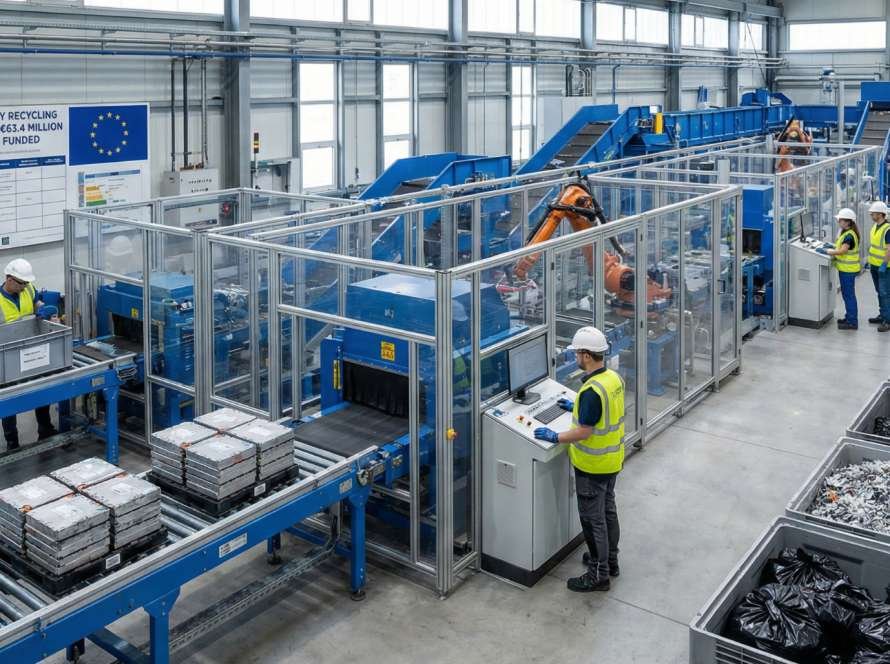
Battery recycling is rapidly emerging as a core pillar of the circular energy economy. It enables the recovery of high-value materials such as lithium, cobalt, nickel, and manganese, elements critical to both electric mobility and stationary energy storage. By reintegrating these resources into production cycles, recycling strengthens supply-chain resilience, mitigates raw-material volatility, and reduces dependency on imports.
Regional Landscape: Asia Leads, Europe Accelerates, North America Scales
Asia Pacific continues to dominate global recycling capacity, supported by its vast EV production ecosystems in China, Japan, and South Korea. Strong government mandates and public-private partnerships have made recycling integral to national industrial policies.
Europe is emerging as the fastest-growing region, propelled by the European Union’s stringent recycling quotas and the European Battery Alliance’s focus on closed-loop manufacturing. The region’s investment in large-scale facilities and traceable supply chains reflects a shift toward full-cycle accountability.
North America is entering a period of rapid expansion. Incentives linked to the U.S. Inflation Reduction Act (IRA) and new Department of Energy programs are stimulating collaboration between automakers and recyclers. Partnerships involving General Motors, Tesla, Redwood Materials, and Li-Cycle illustrate how circularity is becoming central to industrial strategy.
Technology Trends Driving the Market
Lithium-ion batteries currently account for the majority of recycled materials due to their dominance in EVs and energy storage systems. Within recycling methods, hydrometallurgical processes, which use chemical leaching rather than high-temperature smelting, are gaining momentum. These processes yield higher recovery rates, lower energy consumption, and smaller environmental footprints compared to pyrometallurgy.
The market is also seeing increased investment in closed-loop recycling, where recovered metals are directly reintegrated into new battery manufacturing. Automakers and recyclers are forming long-term agreements to secure material supply and meet sustainability targets.
Key Industry Developments
- Li-Cycle is expanding hydrometallurgical “hub-and-spoke” networks across North America.
- Redwood Materials is scaling its operations in the United States to support local cell manufacturers.
- Umicore has launched one of Europe’s largest integrated battery recycling and materials-refining plants.
These initiatives demonstrate a growing emphasis on regional ecosystems designed to capture and reuse resources efficiently, reducing global dependence on raw-material extraction.
Strategic Implications for the Energy Transition
The rise of EV battery recycling marks a critical inflection point for the clean-energy economy. It connects environmental responsibility with industrial competitiveness and energy security.
Governments view recycling as a strategic lever to stabilize mineral supply chains, reduce carbon intensity in manufacturing, and achieve national climate targets. Automakers see it as a means to control costs, hedge against resource scarcity, and align with regulatory demands.
For investors, the sector represents one of the fastest-growing opportunities in the decarbonization value chain, linking sustainability with profitability and long-term resilience.
Second-life EV batteries supporting circular energy systems read more